






The First Pill to Slow Aging Might Come From Your Vet, Not Your Doctor
No drug has ever been approved to extend lifespan, in people or animals. The first one may be a daily pill for senior dogs. Here's how close it is, and what we still don't know.
Furface Studio · October 12, 2026 · 8 min read

Last updated October 2026. This story is moving quickly. We'll update it when the drug's status changes.
There's a moment most dog owners know. You're on the floor with your dog, and you notice the muzzle has gone white. Or the jump onto the sofa now comes in two careful stages. Or the walk that used to be an hour is quietly becoming twenty minutes.
You can't stop that from happening. No one can. But for the first time, a drug designed specifically to slow it down has cleared two of the three hurdles it needs to reach the market. It's a daily pill for senior dogs. If it gets there, it will be the first medicine the U.S. Food and Drug Administration has ever approved to extend lifespan in any species, people included.
That last part is the strange bit. Billions of dollars have been spent chasing human longevity. So why is the first real contender a flavored tablet for a ten-year-old Labrador?
Why dogs got there first
Part of the answer is paperwork. The FDA doesn't recognize aging as a disease in people, so there's no approved pathway for a human drug that simply "treats aging." Anyone trying has to target a specific illness instead and hope the anti-aging effect comes along for the ride.
The FDA's veterinary division has more room to move. It has widened a pathway called conditional approval for pet drugs that fill an unmet need. A drug can go on sale once the company shows it's safe, can be manufactured reliably, and has a "reasonable expectation" of working, while the full proof is still being gathered.
The other part is biology. Dogs live in our homes, breathe our air and often eat our leftovers. They get many of the same age-related diseases we do: cancer, arthritis, heart and kidney problems, cognitive decline. And they do it on a compressed schedule. A trial that would take decades in humans can be run in a few years in dogs.
So a San Francisco company called Loyal decided to start with dogs. Its founder, Celine Halioua, has been blunt about the goal: "My goal has always been to get the first drug FDA approved for lifespan extension."
The Great Dane problem
To see why a dog longevity drug isn't a fantasy, start with a puzzle that has bothered biologists for years.
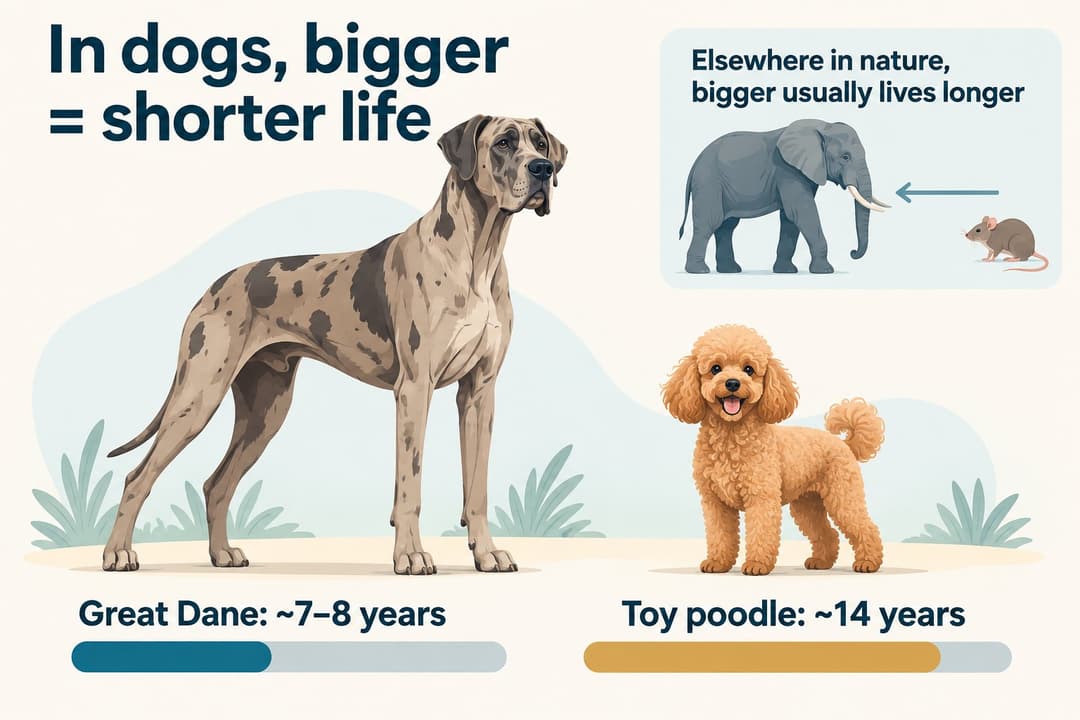
Across the animal kingdom, big usually means long-lived. Elephants outlive mice. Whales outlive almost everything. But within dogs, the rule flips. A Great Dane is old by seven or eight. A toy poodle can be trotting around at fourteen.
In 2013, researchers analyzed records from more than 50,000 dogs across 74 breeds to work out why. Their answer: large dogs don't simply start aging earlier. They age faster. In the researchers' words, a big dog's adult life "unwinds in fast motion."
One prime suspect is a hormone called IGF-1, which drives growth. Big dogs tend to carry more of it, and high IGF-1 has been linked to shorter lives in several species. (We wrote about how far breeding has stretched dogs, from Chihuahua to Great Dane, in What Would Happen to Dogs If Humans Disappeared Tomorrow?) Loyal's two drugs for big dogs, LOY-001 and LOY-003, aim to dial that signal down in adult dogs that have already finished growing.
The important idea here is that aging isn't a fixed clock. It runs at different speeds in different dogs, and something we did, breeding, seems to have changed that speed. If the speed can be changed one way, it may be possible to change it the other way.
Proof that a dog's aging can bend
There's already evidence that it can, and it comes from an unlikely place: a pet food company.
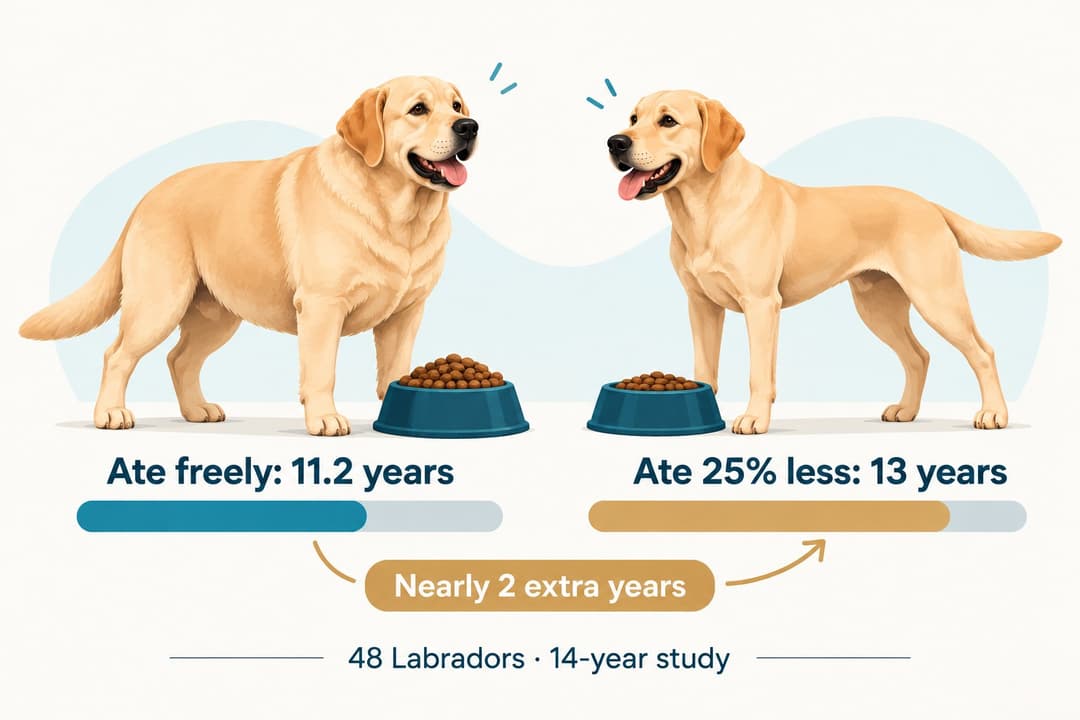
In the 1980s, Purina began a 14-year study of 48 Labrador retrievers from seven litters. Each puppy was paired with a littermate of the same sex and similar weight. One dog in each pair ate freely. The other got 25% less food than its partner and stayed lean.
The lean dogs lived a median of 13 years. Their littermates lived 11.2. That's nearly two extra years, from nothing more exotic than a smaller bowl. The lean dogs also went gray later, kept their muscle longer and stayed active longer. By age 12, eleven of the lean dogs were still alive. Only one of the others was.
That study is the backbone of the argument for LOY-002. Eating less seems to shift the body's metabolism in ways that slow aging. Very few owners can or will keep a dog on careful rations for a lifetime. A pill that produces some of the same metabolic effects would be far easier to live with.
What we actually know about the pill
Here's what Loyal and the FDA have made public about LOY-002:
- It's a daily prescription pill for dogs aged 10 or older and weighing at least 14 pounds.
- It targets age-related "metabolic dysfunction," the gradual breakdown in how the body handles energy.
- Loyal hasn't publicly disclosed the active ingredient.
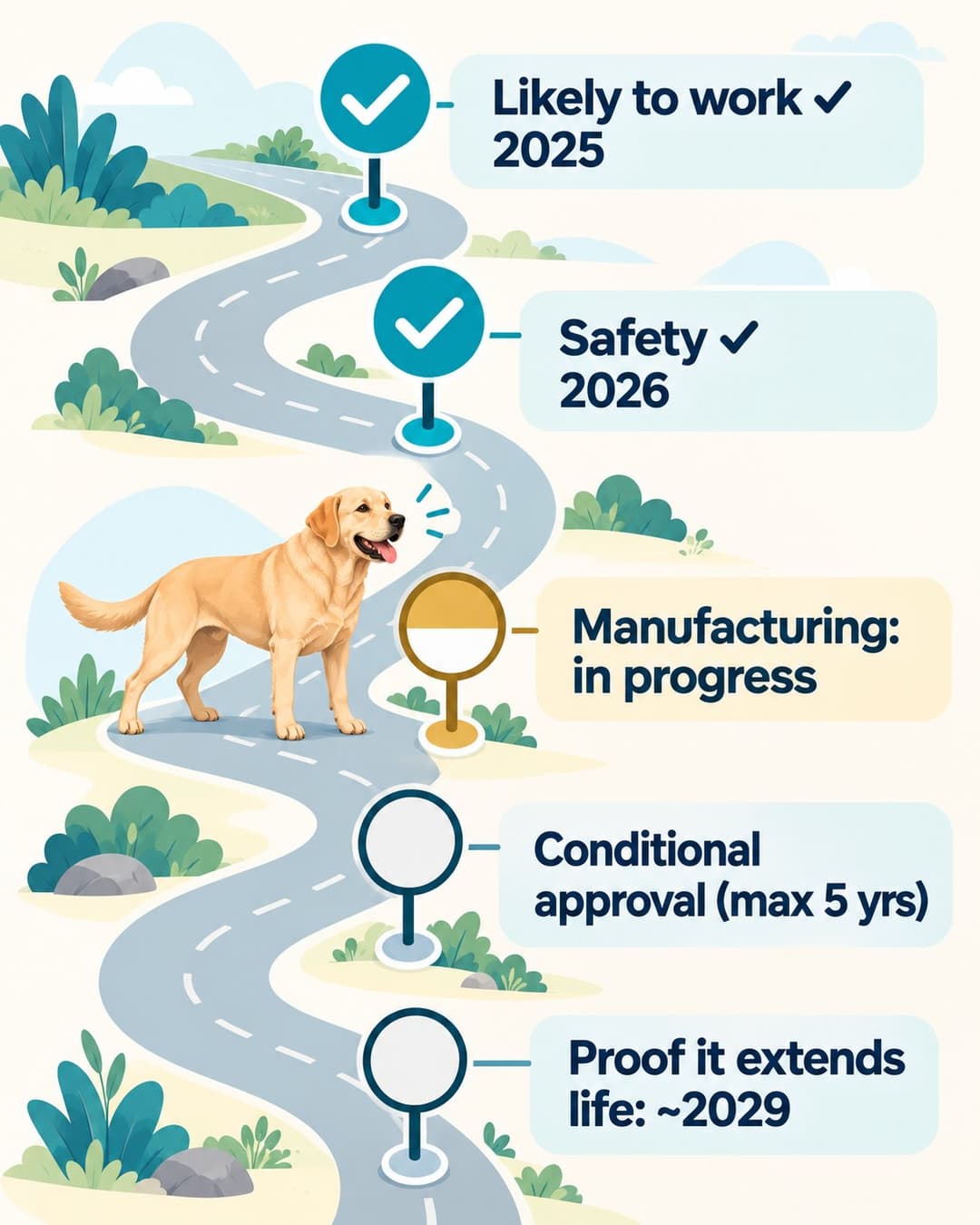
- In February 2025, the FDA accepted that it has a "reasonable expectation of effectiveness." (LOY-001, the injection for big dogs, became the first lifespan drug to reach that milestone in 2023.)
- At the turn of 2026, the FDA accepted its safety data. Dogs were given up to five times the intended dose without clinically significant problems, according to Loyal, and more than 400 dogs in the field trial were included.
- The third requirement, showing it can be manufactured to the FDA's standards, is still in progress. Loyal's statements have pointed to an application for conditional approval in late 2026 or 2027.
Meanwhile, the real test is running. Loyal's STAY study has enrolled 1,300 senior dogs at 70 veterinary clinics across the U.S., in what the company calls the largest clinical trial in veterinary history. It's double-blinded and placebo-controlled: neither the owners nor the vets know which dogs are getting the real pill. Loyal says it's designed to run for about four years.
The catch
This is the part most of the excited headlines leave out. Nobody yet knows whether LOY-002 makes dogs live longer.
A "reasonable expectation of effectiveness" is a real bar, but it's a lower one than proof. It means the FDA found the scientific case plausible, not that the drug has been shown to work. That proof can only come from STAY, and its results are still years away.
Conditional approval reflects that uncertainty. A conditionally approved drug has to carry a label saying it's approved "pending a full demonstration of effectiveness." The approval lasts one year at a time and can be renewed only while the company shows progress toward proof, for five years at most. If the proof never arrives, the drug has to come off the market.
Then there are the practical questions. Loyal hasn't announced a price. Halioua has said she hopes the drug might add about a year of healthy life. That's meaningful for a dog, but it's a hope, not a result. And some observers have raised a fair ethical question: if longevity drugs work, who gets them?
It's also worth knowing that Loyal isn't the only one testing this idea. The Dog Aging Project, a large academic study following more than 50,000 dogs, is running its own NIH-funded trial of rapamycin, an old transplant drug that extends life in mice. That trial aims to enroll 580 dogs, all aged over 7 and weighing at least 44 pounds. Two very different approaches, run by a company and by universities, give everyone a better chance of finding out what's real.
What you can do now
You don't have to wait for a pill to act on the one piece of evidence we already have. Those Labradors in the Purina study didn't get a drug. They got less food, and they kept a healthier weight their whole lives.
Keeping your dog lean is free, it's safe, and it has decades of evidence behind it. If you're not sure what a healthy weight looks like for your dog, ask your vet. It's one of the most useful questions you can ask at a checkup.
The bigger picture
If LOY-002 works, the first patient to be prescribed an approved medicine for aging itself won't be a billionaire in a longevity clinic. It will be somebody's gray-muzzled dog, at an ordinary vet's office.
And if it works in dogs, who share our homes, our habits and our diseases, it will make the case that aging itself can be treated, in people too, much harder to dismiss.
For now, the honest answer to "can a pill help my dog live longer?" is: maybe, possibly soon, and we'll know far more by the end of the decade. In the meantime, the white muzzle on the floor beside you is still the best reason to make every walk count.
Sources
- Loyal (2026). Loyal receives FDA acceptance of safety package for senior dog lifespan extension drug. Business Wire.
- Loyal (2026). Product brief for veterinarians.
- Loyal (2026). Loyal raises $100M Series C to advance the first canine longevity drug. Business Wire via The Galveston County Daily News.
- dvm360 (2026). Lifespan extension drug in development for senior dogs reaches a new milestone.
- Deseret News (2026). Loyal's new drug aims to extend life span of dogs.
- U.S. Food and Drug Administration. Conditional approval explained: a resource for veterinarians.
- NPR (2024). A cheap drug may slow down aging. A study will determine if it works.
- Kraus, C., Pavard, S. and Promislow, D. E. L. (2013). The size–life span trade-off decomposed: why large dogs die young. The American Naturalist. Reported by Inside Science.
- Kealy, R. D. et al. (2002). Effects of diet restriction on life span and age-related changes in dogs. Journal of the American Veterinary Medical Association. Summarized by Purina.
- Harrison, D. E. et al. (2009). Rapamycin fed late in life extends lifespan in genetically heterogeneous mice. Nature.
- Texas A&M (2024). Dog Aging Project expands rapamycin trial.
- Ara (2025). Pills to delay your pet's aging: is it ethical?
This article is for general interest and isn't veterinary advice. Talk to your vet before changing your dog's diet or treatment.
Ever wondered how your pet would look in a portrait?
Try it free with any of our designs and see the result in about 60 seconds.
Browse designs →