



It Took 20 Gene Edits to Make a "Dire Wolf." Here's What That Says About Your Chihuahua
The world argued about whether Colossal really brought back the dire wolf. The more interesting question is how 20 edits could change a wolf so much, and the answer is lying on your sofa.
Furface Studio · October 12, 2026 · 6 min read
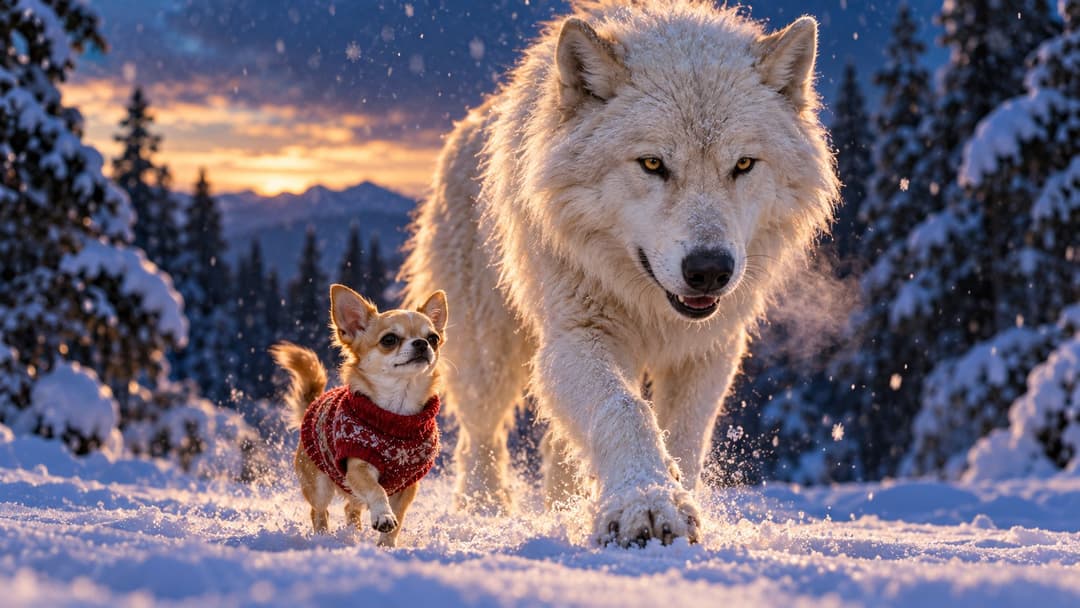
In April 2025, a company called Colossal Biosciences released photos of three enormous white wolf pups and announced that it had brought back the dire wolf, a predator that vanished more than 10,000 years ago and was made famous all over again by Game of Thrones.
Within days, the internet split into two camps. One said: science fiction just became science. The other said: those aren't dire wolves, they're gray wolves with a makeover.
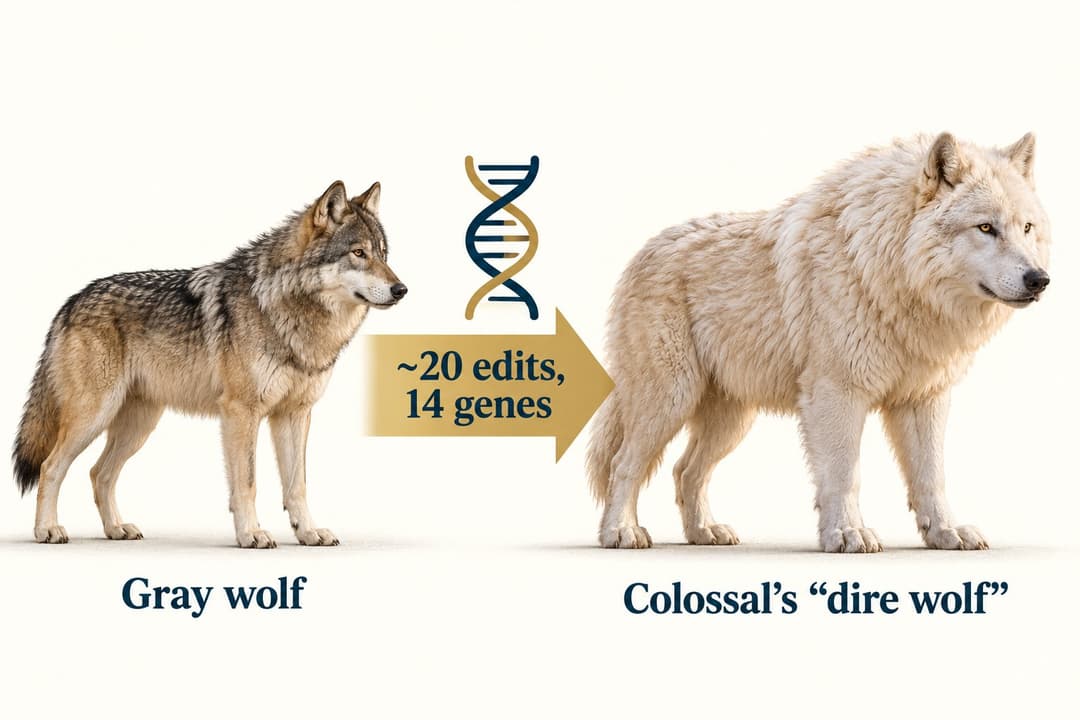
The second camp turned out to be closer to the truth. A month later, Colossal's own chief scientist described the animals as "gray wolves with 20 edits."
But the argument over what to call them missed the most interesting part of the story. The real question isn't whether these are dire wolves. It's how a mere 20 changes could make a wolf look like a different animal. And the best evidence for the answer isn't in a lab. It's lying on your sofa, probably upside down.
What Colossal actually did
The three animals are named Romulus, Remus and Khaleesi. The brothers were born on October 1, 2024, and their sister on January 30, 2025.
To make them, Colossal's scientists first read DNA from two dire wolf fossils: a 13,000-year-old tooth from Ohio and a 72,000-year-old ear bone from Idaho. They compared it with the gray wolf genome and picked out differences they believed mattered. They didn't paste any ancient DNA into a living animal.
Instead, they took ordinary gray wolf cells, from blood samples, and used the gene-editing tool CRISPR to change 14 genes in about 20 places. Fifteen of those edits copied versions found in the dire wolf genome. The other five were known variants for a pale coat. The edited cells became embryos, and the embryos were carried by domestic dogs acting as surrogate mothers.
The result is a pack of large, pale, broad-headed wolves. Colossal says they're about 20% bigger than gray wolves of the same age. In September 2026, with the brothers about to turn two, the company said they were living as a pack on a 2,000-acre preserve and that it was working on another litter.
Why scientists said "not so fast"
The pushback came quickly. Jeremy Austin, an Australian ancient-DNA researcher, said the result was "not a dire wolf under any definition of a species ever." The canid specialists at the International Union for Conservation of Nature concluded the project didn't contribute to conservation. MIT Technology Review later put it on its list of the worst technology flops of 2025.
The reason comes down to deep time. Genetic studies suggest the dire wolf's lineage split from the ancestors of gray wolves around 4.5 to 5.7 million years ago. Colossal's estimate is the more recent one, and it argues for some ancient interbreeding along the way. Either way, that's millions of years of separate evolution: countless small differences scattered across the genome, affecting everything from metabolism to behavior. Twenty edits can't recreate that.
So the critics were right. These are gray wolves with dire-wolf-inspired features.
And yet, look at them. They really are huge, pale and heavy-jawed. Twenty edits out of a genome of billions of letters made an animal that most people took for a different species.
That's the part worth thinking about.
Looks are genetically cheap
It turns out that the things our eyes notice first in an animal (size, color, coat) are often controlled by a surprisingly small number of genes. A single change in the right place can make a big, visible difference.
Dog breeders discovered this long before anyone could read DNA. They just didn't know why it worked.
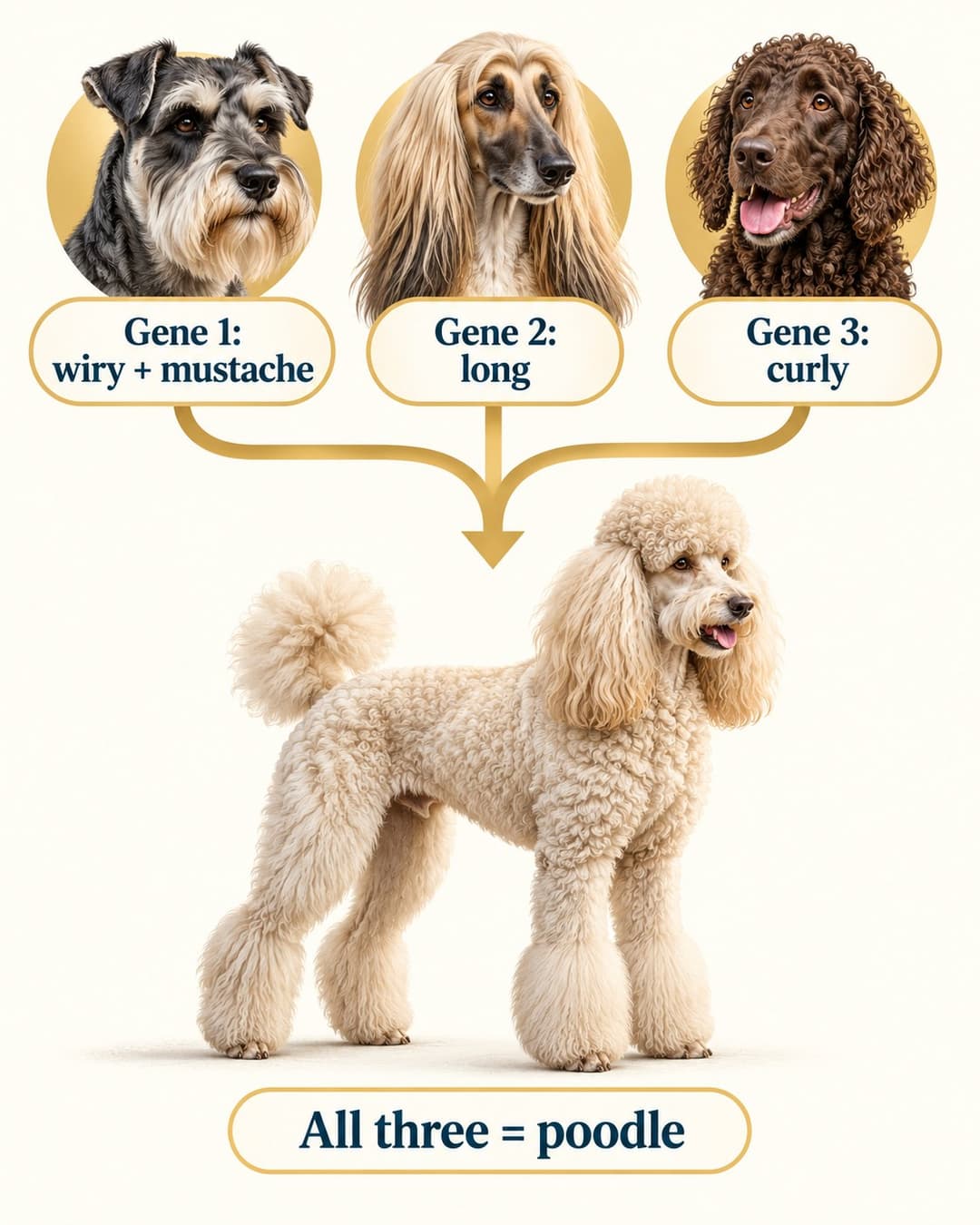
Take coat. In 2009, researchers studied more than 1,000 dogs from 80 breeds and found that variants in just three genes account for almost every dog coat type. One gene gives wiry hair and a scruffy mustache. Another makes hair long and silky. A third makes it curly. Mix and match those three, and you get everything from a Labrador's sleek coat to a schnauzer's beard. Have all three at once and you get a poodle.
Size works the same way, more or less. A 2013 study found that variants in just six genes explain nearly half of the size reduction in small dog breeds. One of the most important is IGF1, a growth hormone gene. Small breeds share a version of it that turns the growth signal down. (That same hormone turns up again in the science of why big dogs die young, which we explored in The First Pill to Slow Aging Might Come From Your Vet, Not Your Doctor.)
Even Colossal ran into a dog-breeding lesson. The dire wolf's own version of one coat-color gene carries a risk of blindness and deafness, so the scientists used a different light-coat variant, one known from dogs, instead. Dog breeders know that problem well. In dogs, some white-coat genes travel with deafness, and Dalmatians are the famous example.
Your Chihuahua is the bigger experiment
Now put that next to the dog on your sofa.
Every dog alive descends from wolves. And in the last 200 years or so, breeders have pushed dogs into a range of shapes no wild canid has ever produced. A Great Dane can weigh more than 30 times as much as a Chihuahua. One has the face of a pug; another, the narrow snout of a borzoi. If an alien zoologist lined them up, it would assume they were dozens of different species.
They aren't. They're all one species (many biologists even count dogs as a kind of gray wolf), and they can all interbreed. The visible differences between them come largely from a modest set of genetic switches for size, coat, color and face shape, flipped in different combinations, selected by people over many generations.
In other words, humans have been running Colossal's experiment for thousands of years, just much more slowly and with no lab. We didn't edit genes. We chose which dogs had puppies, and let nature hand us the variants. Colossal did in about two years, deliberately, what breeders did over centuries by trial and error.
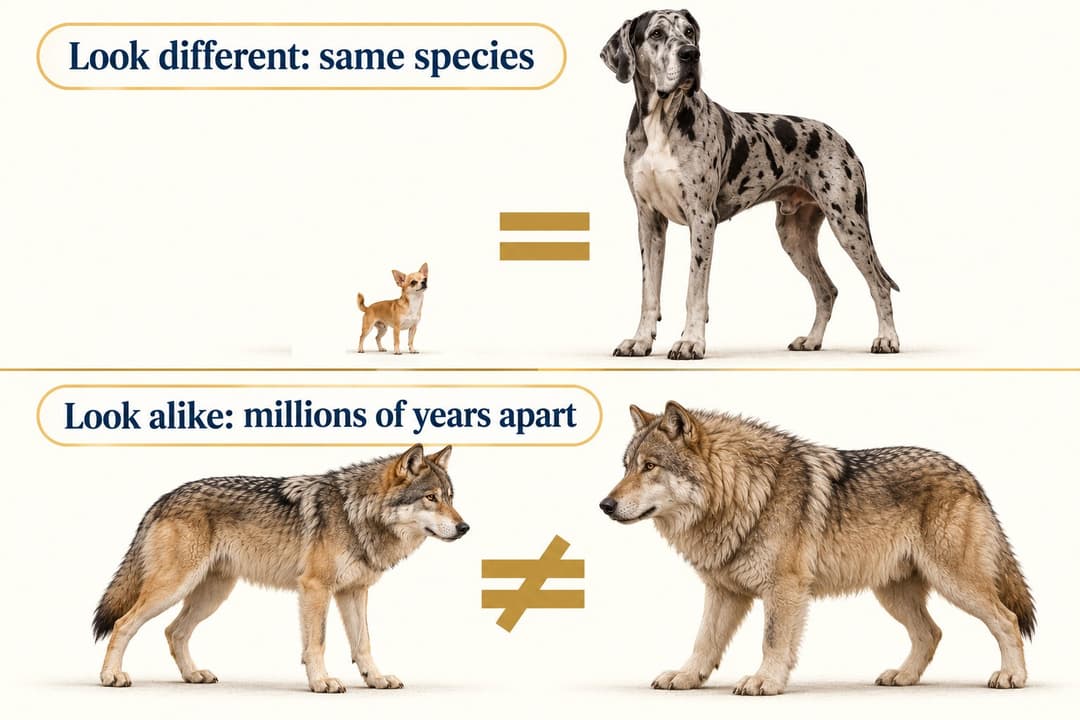
Here's the twist. Looks lie in both directions:
- A Chihuahua and a Great Dane look like different animals, but they're the same species, separated by a few hundred years of breeding.
- A gray wolf and a real dire wolf looked broadly similar, two big wolf-like predators, but they came from lineages that had been apart for millions of years.
Appearance is the most obvious thing about an animal, and the least reliable guide to what it really is.
So what are Romulus, Remus and Khaleesi?
Probably the most honest answer is: something new. They're not resurrected dire wolves. But they're not quite ordinary gray wolves either. They're a living demonstration that a handful of genetic changes can redraw an animal's outline.
Whether that's a good thing is a fair debate. Supporters see the same tools one day helping endangered species, and Colossal has also produced cloned red wolves, one of the most endangered canids in the world. Critics worry that "de-extinction" headlines make extinction feel reversible, when it isn't, and pull attention and money from protecting animals that are still here.
What isn't really up for debate is the lesson hiding in plain sight. When Colossal made 20 edits and got a wolf the world mistook for a monster from the Ice Age, it wasn't revealing something new about genetics. It was showing us, very quickly and very publicly, what we've been doing to dogs all along.
Your Chihuahua is the proof. Fifteen thousand or more years ago, its ancestors were wolves. Now it shivers in a sweater and growls at the vacuum cleaner. Twenty edits? It's been through far stranger.
If your own small wolf deserves a throne, our Game of Bones collection has one waiting.
Sources
- Wikipedia. Colossal Biosciences dire wolf project. Summary of the announcement, methods, and expert responses, with links to primary coverage.
- Colossal Biosciences. The return of the dire wolf.
- AOL / People (2026). Colossal's dire wolves are turning two, and the next litter is already underway.
- National Geographic. What paleontologists say about Colossal's dire wolves.
- Perri, A. R. et al. (2021). Dire wolves were the last of an ancient New World canid lineage. Nature. Reported by Sci.News.
- IUCN SSC Canid Specialist Group. Statement on gene editing in wild canids.
- Cadieu, E. et al. (2009). Coat variation in the domestic dog is governed by variants in three genes. Science. Summary from NHGRI.
- Rimbault, M. et al. (2013). Derived variants at six genes explain nearly half of size reduction in dog breeds. Genome Research.
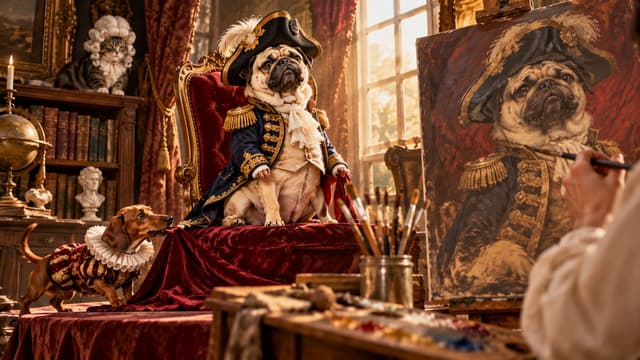
The images in this article are illustrations.
Ever wondered how your pet would look in a portrait?
Try it free with any of our designs and see the result in about 60 seconds.
Browse designs →