
What Would Happen to Dogs If Humans Disappeared Tomorrow?
Most people think they'd turn back into wolves. The dogs already living without us point to a far less obvious survivor.
Furface Studio · October 12, 2026 · 8 min read
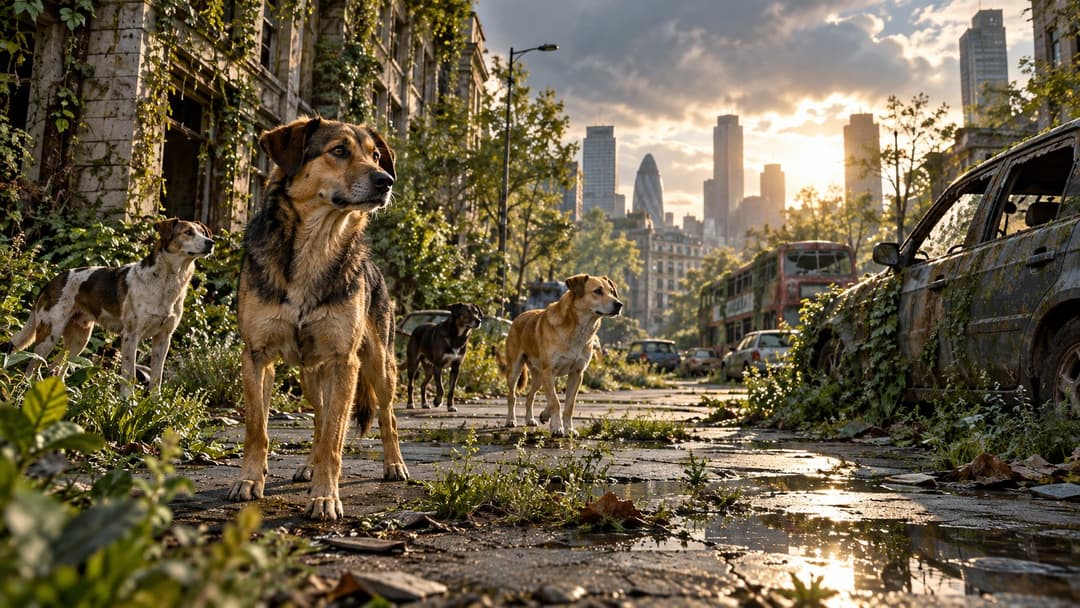
Picture tomorrow morning with nobody in it. The garbage trucks don't come. The traffic lights keep cycling for empty junctions until the power fails. And in millions of homes, a dog waits by the door for someone to come down the stairs.
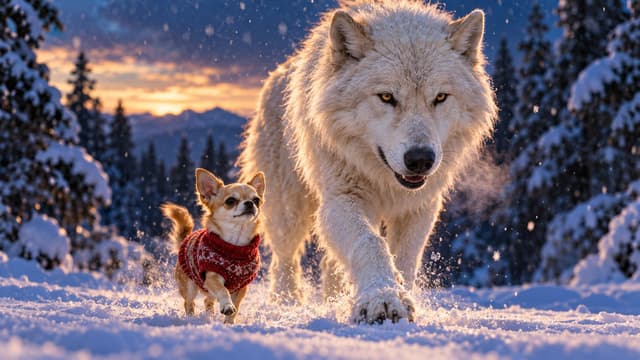
Ask most people what happens to the dogs next and you'll get some version of the same answer: they'd go wild and, give it long enough, they'd turn back into wolves. It's a satisfying idea. It's also almost certainly wrong.
We don't have to guess as much as you'd think, though. Dogs have been running small versions of this experiment for a long time: across Australia, where dingoes have lived largely on their own terms for thousands of years, in a nuclear exclusion zone people abandoned in 1986, and on the streets of most of the world's towns, right now. Put that evidence together and it points to a surprising winner. It isn't the wolf, and it isn't the toughest-looking breed in the park. It's a dog you've probably walked past a hundred times without noticing.
The first to die might never leave the house
The opening weeks would be hard to read about, so let's be brief and honest. A dog shut inside an apartment depends on someone to open a tap and a door. Puppies need frequent feeding. Plenty of dogs rely on daily medication. For a lot of them, the problem wouldn't be the wild. It'd be the walls.
Dogs that got out would face a different shock. Chasing a ball isn't the same as catching dinner, and a dog that's always had a bowl put down for it has never had to learn where food comes from, which animals to avoid or where to sleep out of the rain.
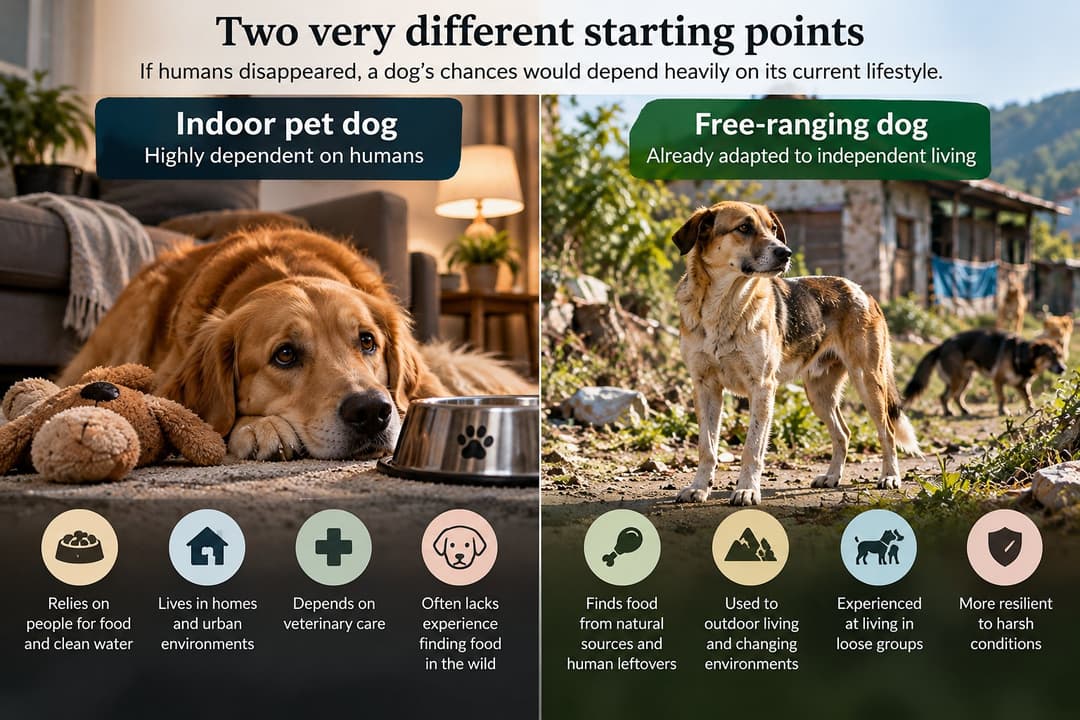
But "pet dogs" aren't one population, and that's the first thing the wolf idea misses. A dog that already spends its days roaming, sniffing out scraps and finding its own shelter starts from a completely different place than one that's barely been off a leash. Breed matters less here than experience, health and plain luck.
Three out of four dogs are already living the experiment
Here's the fact that reframes the whole question. The dog curled up on a sofa is the exception. Of the world's roughly 700 million dogs, around three-quarters are thought to be free-roaming: village dogs, street dogs and community dogs that come and go as they please (Smith et al., 2019).
Most of them aren't truly wild. In Bangalore, for example, researchers found street dog numbers tracked houses, bakeries and garbage piles, and many dogs leaned heavily on particular households that fed them (Bhalla et al., 2021). They live alongside us rather than with us.
And it's a tough life. A five-year study in West Bengal, India, followed 364 free-ranging puppies from 95 litters. Only about 19 percent made it to seven months old. Strikingly, around 63 percent of the deaths were linked to people: road accidents, poisoning, beatings and pups being taken away (Paul et al., 2016). Those figures come from particular communities and can't be stretched to every street dog on Earth, but they puncture the image of the carefree stray.
So what happens to these dogs if we vanish? At first, they'd have the edge. They already know how to forage and where to bed down. Some of the dangers that kill them would vanish with us, too, though so would the scraps and the kind households. A world of abandoned shops and kitchens would be a feast for a few months, then it'd rot. After that, the dogs would need to hunt, scavenge carcasses and eat whatever their surroundings offered, while competing with animals that were already good at it.
They'd be starting the race from further up the track. They wouldn't be guaranteed to finish it.
What happened when people left Chernobyl
There's one place where people really did leave, more or less overnight. When the area around the Chernobyl nuclear plant was evacuated in 1986, many pets were left behind. Their descendants are still there.
In 2023, researchers published the first detailed genetic study of these dogs, using blood samples from 302 of them (Spatola et al., 2023). They found the dogs living at the power plant and in Chernobyl city are genetically distinct from free-breeding dogs elsewhere in Eastern Europe and beyond, and that they're made up of several family groups.
It's tempting to read that as evolution in action, but the researchers were careful not to blame radiation for the differences yet. And the zone isn't truly human-free: workers still maintain the plant and many of them feed the dogs. Here's the telling part. Real wolves have moved into the exclusion zone in large numbers since the people left. Nearly four decades on, the dogs living alongside them still haven't become anything like them. They're scruffy, medium-sized dogs.
Why a Chihuahua wouldn't turn into a wolf
The wolf idea feels intuitive because dogs really did come from an ancient wolf population, and they're still close relatives of gray wolves. Ancient DNA shows dogs had already split into several distinct lineages by about 11,000 years ago, though exactly where and how domestication happened is still argued over (Bergström et al., 2020).
But evolution doesn't run backward like a film on rewind. It has no destination in mind. It simply means that the animals who happen to survive and breed pass on their traits, and over many generations those traits become more common. Remove humans and you don't get a return ticket to the wolf. You get whatever the surviving dogs and their particular surroundings produce.
Those surroundings would vary enormously. A thick coat is a lifesaver in a Canadian winter and a liability in a Brazilian summer. A big body wins fights but needs a lot of food. A small dog needs very little but is easier prey. There's no single winning design, which is exactly why there'd be no single future dog.
The real winner might be the dog nobody notices
If you want to see how dogs look after thousands of years largely left to their own devices, look at the dingo.
Dingoes are descended from domestic dogs that traveled with people, most likely from Asia. The oldest securely dated dingo bones in Australia, from Madura Cave on the Nullarbor Plain, are between about 3,100 and 3,350 years old (Balme, O'Connor and Fallon, 2018). For most of that time, they've largely hunted and bred on their own terms, on a continent with no wolves to compete with, though many lived alongside Aboriginal people too.
They still haven't turned into wolves. They look like a lean, medium-sized dog with prick ears and a short, sandy coat. Which is roughly what the free-roaming dogs of many villages and towns around the world look like too.
That's a pattern worth noticing, though it isn't a law. When people stop choosing which dogs breed, the extremes tend to fade. Pedigree lines blur within a few generations as dogs mate with whoever's around, and the costly features we've selected for, like very flat faces, very short legs or very heavy bodies, get no special protection. What's left often drifts toward a sensible, middle-of-the-road dog.
Size and toughness won't decide it either. A short-nosed dog can struggle to cool down during hard exercise. A giant breed burns through calories it can't easily replace. The survivors in most places probably wouldn't be the biggest or the fiercest. They'd be the most ordinary.
Would they hunt in packs like wolves?
Some would, some wouldn't. Wolves are specialists at cooperative hunting, and they learn it from their families. Free-roaming dogs are much more flexible: some live in loose groups, some largely alone, and most scavenge far more than they hunt.
Hunting isn't a switch that flips when the food bowl disappears. A dog that's never had to catch anything wouldn't suddenly become good at it. The likeliest picture is a mix of strategies depending on what's nearby: some groups getting better at taking prey together, others living on small animals, insects, carrion and whatever else they can find.
They'd also make their mark on everything around them. Free-roaming dogs already prey on wildlife, compete with other carnivores and spread disease, with problems recorded on every continent where people have studied them (Hughes and Macdonald, 2013). In a world without us, dogs would change their surroundings as much as their surroundings changed them.
A thousand years later, would we recognize them?
Probably, in most places. Over time the cities would crack and turn green, and different populations would face very different pressures. Natural selection would favor whatever helped in each place. Random chance would play a part too, especially in small, isolated groups, where some traits can become common simply by luck. Coats, body size, behavior and wariness of strangers could all shift.
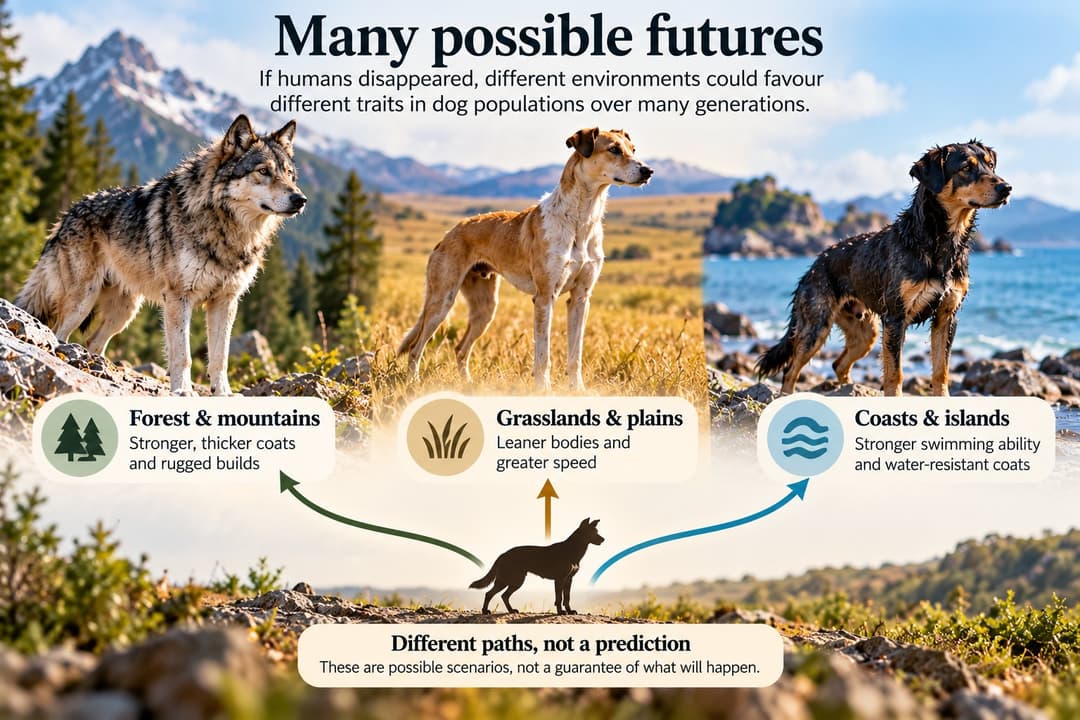
But a thousand years is only a few hundred dog generations. That's enough for real change, but we shouldn't expect wildly new animals on a neat schedule. The dingo has had three times as long and is still recognisably a dog.
There's a subtler point here too. A dog with a wolfish coat in a snowy forest wouldn't be a return to the past. It'd be a new solution to an old problem, built from the genes our dogs happen to carry today, including everything we bred into them.
So, what would really happen?
For many pet dogs, the first weeks would be brutal. Free-roaming dogs would have a head start, but they'd still face hunger, disease, injury and rivals. Some lineages would disappear. Others would adapt in ways that would vary from one landscape to the next.
What wouldn't happen is a worldwide march back to the wolf. The evidence we have, from Australia's dingoes to the dogs of Chernobyl and the hundreds of millions of dogs already living on our streets, points the other way. Without us picking and choosing, dogs seem to settle on something plainer: medium-sized, short-coated, alert and adaptable.
For at least 15,000 years, and possibly far longer, we've shaped what dogs look like. We made the Chihuahua and the Great Dane, the Pug and the Greyhound. If we disappeared tomorrow, most of that handiwork would quietly fade. What would carry on isn't the wolf our dogs came from. It's the plain, clever, adaptable dog that's been there all along, waiting for us to stop fussing.
Sources
- Smith, L. M. et al. (2019). The effectiveness of dog population management: a systematic review. Animals.
- Bhalla, S. J. et al. (2021). 'Stray appetites': a socio-ecological analysis of free-ranging dogs living alongside human communities in Bangalore, India. Urban Ecosystems.
- Paul, M. et al. (2016). High early life mortality in free-ranging dogs is largely influenced by humans. Scientific Reports.
- Spatola, G. J. et al. (2023). The dogs of Chernobyl: demographic insights into populations inhabiting the nuclear exclusion zone. Science Advances.
- Bergström, A. et al. (2020). Origins and genetic legacy of prehistoric dogs. Science.
- Balme, J., O'Connor, S. and Fallon, S. (2018). New dates on dingo bones from Madura Cave provide oldest firm evidence for arrival of the species in Australia. Scientific Reports.
- Hughes, J. and Macdonald, D. W. (2013). A review of the interactions between free-roaming domestic dogs and wildlife. Biological Conservation.
The images in this article are illustrations, not photographs. The scenario is a thought experiment: no study can tell us exactly what would happen if people vanished.
Ever wondered how your pet would look in a portrait?
Try it free with any of our designs and see the result in about 60 seconds.
Browse designs →